
EdgeFinder
Forex, Indices, And Commodities Scanner

An objective analysis of scaling, risk management, and algorithmic execution in financial markets.
A grid trading system or automated Expert Advisor (EA) removes the stress of trying to time the perfect market entry. Instead of relying on a single entry point, a grid system places multiple pending buy or sell orders at regular intervals above or below a baseline price. As the market moves, it systematically executes these levels, effectively scaling into positions to lower your overall average cost basis. While popular in cyclical or range-bound environments, executing this approach requires strict mathematical discipline to avoid sudden capital liquidation.
Automated grid strategies offer several core structural benefits that appeal to algorithmic and manual traders alike:
One of the largest psychological hurdles in trading is finding the exact moment to enter a position. Grid systems bypass this entirely by focusing on building a position structure over a defined price range, rather than relying on a single, perfect technical execution point.
The core concept of a grid is simple and easy to automate. It capitalizes on the naturally cyclical behavior of financial markets—such as the major Forex pairs—which frequently fluctuate back and forth within multi-week structural ranges before sustaining a long-term directional move.
Because grid systems continuously accumulate positions and harvest profits whenever the market makes a minor counter-reversal, they inherently boast very high statistical win rates over long periods of consolidation.
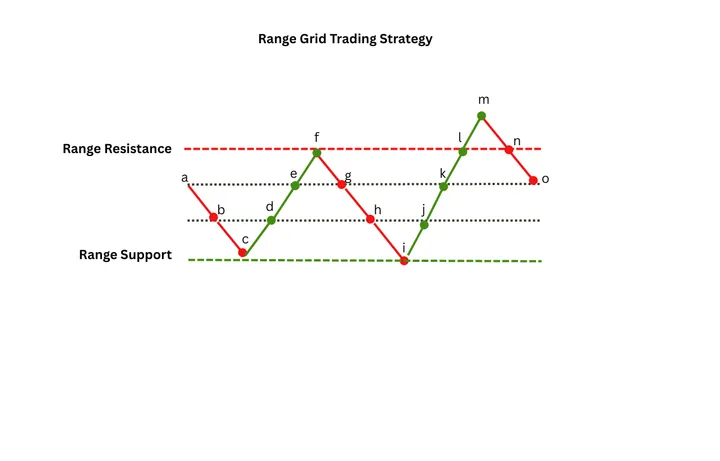
Visualizing a range-bound grid trading strategy setup where buy and sell orders accumulate within a set consolidation channel.
Deploy a rules-based system engineered with proper risk management metrics and structure bounds.
Explore our custom Indicator + Grid Trading RobotDespite high historical win rates, grid trading carries asymmetric tail-risk that can devastate unmanaged trading accounts:
To give trades room to breathe and recover, many commercial grid robots operate entirely without a hard stop loss. If a market enters a strong, sustained macro trend without pulling back, an unmanaged grid will continue adding losing positions, exposing the entire account to a complete margin wipeout.
Scaling into multiple positions requires deep capital reserves. Attempting to run a grid matrix on a small retail account leaves virtually zero room for error, as floating drawdown will quickly overwhelm account leverage during normal market swings.
While the strategy collects small, frequent profits during quiet markets, it leaves massive open-ended drawdown exposure when markets experience unexpected black swan volatility or rapid structural breakouts.
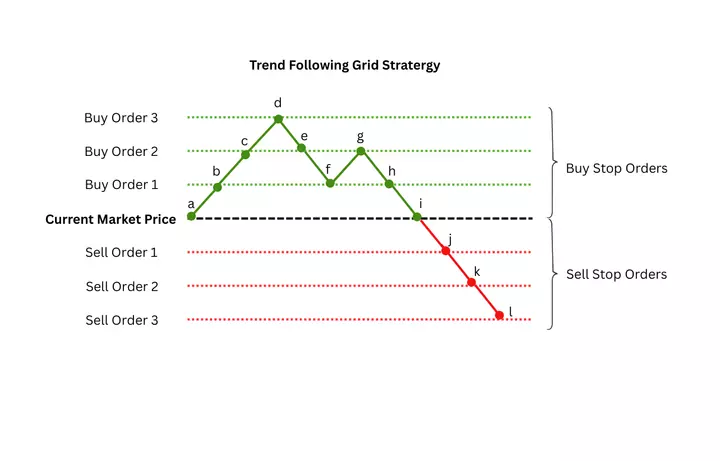
Example of a trend-following grid system layout where buy orders are scaled and stacked continuously in alignment with an active breakout.
To run a grid system successfully over the long term without blowing your account, you must apply three non-negotiable optimization guardrails:
Ultra-Conservative Lot Sizing: Keep position sizes exceptionally small relative to your total capital balance. For example, trading micro lots on a base capital allocation gives your grid ample room to absorb deep market swings and volatile historical spikes without triggering a margin call.
Wide Level Dispersions: Spacing your grid levels further apart means individual trades require more time to mature. However, wider pacing significantly reduces structural risk, allowing the price matrix to capture macro swings over a broader range while minimizing consecutive order exposure.
Aligning with Market Fundamentals: Never deploy a purely technical grid into a vacuum. Filter your grid's directional bias by analyzing macroeconomic indicators such as global interest rates, employment metrics, or central bank policies. If the long-term fundamental trend favors a specific direction, design your grid to only execute buys during dips, avoiding the danger of fighting a macro trend.
Use this technical framework to evaluate when a grid system is suitable for your market environment:
| Market Environment | Account Parameters | Tactical Risk Action |
|---|---|---|
| Low-volatility consolidation range with strong backing fundamentals | High capital balance ($10,000+) + Minimal lot sizes (0.01) | Viable Environment (Low-risk accumulation zone) |
| Market approaching major high-impact macro news or central bank decisions | Any account configuration with open positions facing trend breakouts | Pause Grid Operations (High risk of an unhedged breakout) |
| Aggressive technical breakout following major economic shifts | Underfunded retail account (Under $1,000) using tight step intervals | Critical Hazard (Severe risk of rapid account liquidation) |
Swipe horizontally to view full table metrics if viewing on mobile.


